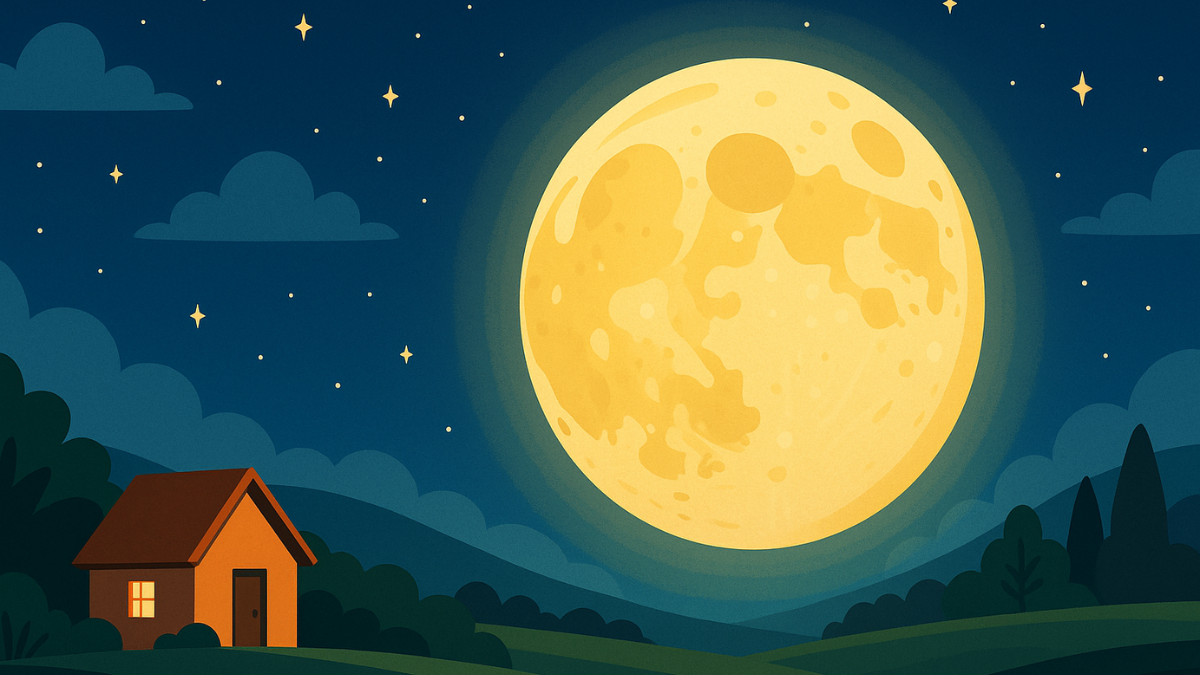
People across Enniskillen and County Fermanagh will have another reason to look to the skies this month, with a deep partial lunar eclipse taking place during the early hours of Friday 28 August.
The eclipse comes just over two weeks after the partial solar eclipse on 12 August and will see around 93% of the Moon move into the darkest part of Earth’s shadow at its peak.
If the skies remain clear, a large part of the Moon could take on a striking reddish or copper colour during the eclipse.
What is a partial lunar eclipse?
A lunar eclipse happens when the Earth moves between the Sun and the Moon, causing the Moon to pass through Earth’s shadow.
During this month’s eclipse, most – but not all – of the Moon will move into the darkest part of Earth’s shadow, known as the umbra.
As this happens, the eclipsed part of the Moon can appear red or copper in colour.
Unlike the solar eclipse earlier this month, you don’t need any special glasses to watch a lunar eclipse. It is completely safe to look at with the naked eye.
What time will the lunar eclipse happen?
You’ll need to be prepared for a very early start – or a very late night!
The first, more subtle stage of the eclipse begins at around 2:23am on Friday morning.
The more noticeable partial eclipse begins at around 3:33am, before reaching its maximum at approximately 5:12am.
At this point, around 93% of the Moon will be within Earth’s darkest shadow.
The Moon will then be getting increasingly low in the sky as morning approaches.
Key times:
| Stage | Time |
|---|---|
| Penumbral eclipse begins | 2:23am |
| Partial lunar eclipse begins | 3:33am |
| Maximum eclipse | 5:12am |
| Partial eclipse ends* | 6:51am |
Timings are in BST. Moonset varies depending on location.
Where should you look from Fermanagh?
As the eclipse progresses, the Moon will become increasingly low in the sky.
For the best chance of seeing as much of the eclipse as possible, you’ll want somewhere with a clear, unobstructed view towards the south-west and western horizon.
Higher ground or an open location without buildings, trees or hills blocking the horizon could provide a better view, particularly as the eclipse approaches its maximum.
You don’t need a telescope or binoculars to enjoy the eclipse, although either could provide a closer look.
Why could the Moon turn red?
You may sometimes hear a lunar eclipse described as a “Blood Moon” because of the reddish colour the Moon can take on.
Even though the Earth is blocking direct sunlight from reaching the eclipsed part of the Moon, some sunlight still passes through Earth’s atmosphere.
Our atmosphere scatters much of the blue light while allowing more red and orange light to reach the Moon, which can give it that distinctive copper or reddish appearance.
Exactly how noticeable the colour will be can vary.
Another big month for Fermanagh’s night sky
August has already been a busy month for anyone interested in looking up.
We had the partial solar eclipse on 12 August, followed by the Perseid meteor shower, and now we have another eclipse to finish off the month.
Interestingly, the timing isn’t a coincidence. Solar and lunar eclipses often occur around two weeks apart because of the alignment of the Sun, Earth and Moon.
Will we see it from Fermanagh?
And, as always, this is where the Fermanagh weather comes into it!
Cloud cover will ultimately decide how much of the eclipse we’re able to see.
The good news is that there’s still plenty of time before 28 August, so it’s far too early to say what viewing conditions will be like.
We’ll keep an eye on the forecast over the coming days and provide a local weather update for Enniskillen and Fermanagh closer to the eclipse.
Hopefully this time the clouds will be a little kinder to us!