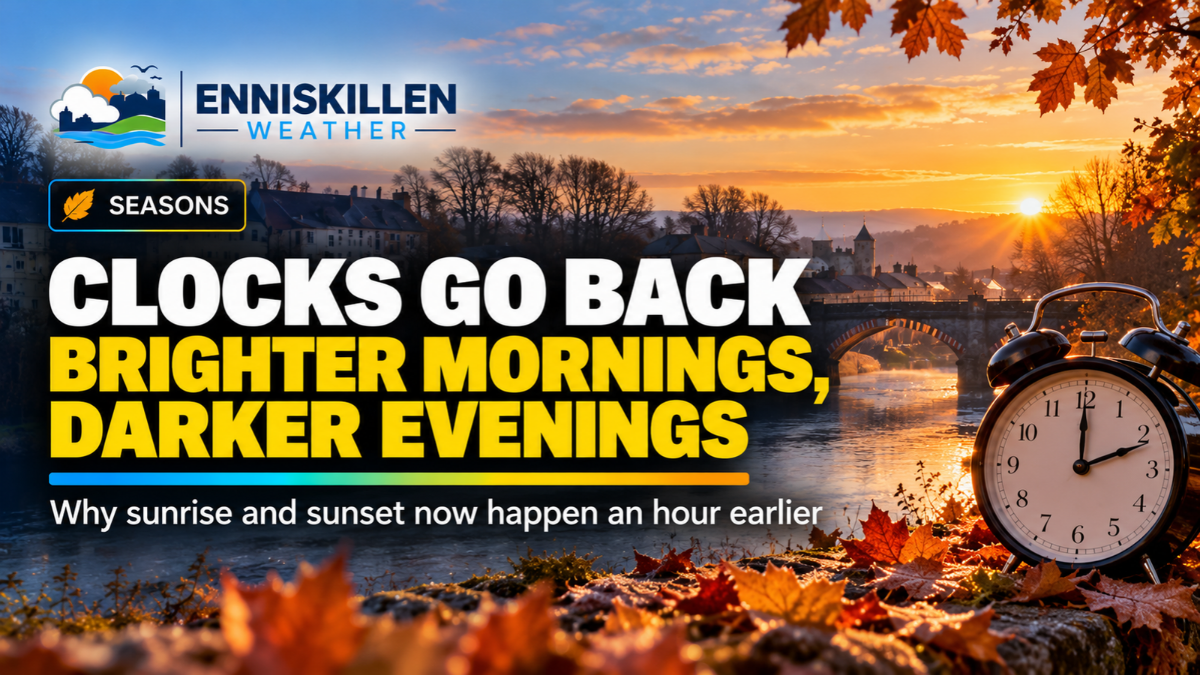
If you’ve noticed that the mornings seem a little brighter but the evenings are getting darker much earlier, there’s a simple reason!
The clocks went back one hour on Sunday 25 October 2026, marking the end of British Summer Time (BST) and the return to Greenwich Mean Time (GMT).
And while we all enjoyed that extra hour in bed, the change also means that sunrise and sunset are now happening around an hour earlier according to our clocks.
What difference has the clock change made?
To give you an idea of how things have changed, let’s take a look at the sunrise and sunset times for Enniskillen.
Saturday 24 October 2026 (Before the clocks changed)
- Sunrise: 8:16am
- Sunset: 6:13pm
Monday 26 October 2026 (After the clocks changed)
- Sunrise: 7:20am
- Sunset: 5:09pm
That’s quite a noticeable difference!
Before the clocks changed, we were waiting until after 8am for sunrise. Now, the Sun is rising shortly after 7am.
However, the opposite happens in the evenings.
Instead of sunset taking place after 6pm, we’re now seeing the Sun disappear below the horizon shortly after 5pm.
Why does this happen?
The explanation is actually quite simple.
When the clocks go back, we’re moving from British Summer Time to Greenwich Mean Time.
This means the time shown on our clocks moves back by one hour, but the Sun itself hasn’t suddenly changed its position in the sky.
We’re simply measuring the same natural daylight using a different clock time.
That’s why sunrise and sunset appear to happen around an hour earlier.
Are we losing an hour of daylight?
Not because of the clock change!
Although it might feel like we’ve suddenly lost an hour of daylight in the evenings, the total amount of daylight doesn’t change simply because we’ve adjusted our clocks.
However, there’s another change happening naturally at this time of year.
As we move further into autumn, our days continue to get shorter and our nights longer.
That’s why the sunrise and sunset times will continue to change throughout November and into December.
Brighter mornings, but darker evenings
For many people, the biggest benefit of the clock change is having a little more daylight in the mornings.
Those heading out to work, school or college may notice that it’s brighter than it was at the same time last week.
However, the trade-off is that darkness arrives earlier in the evenings.
And as we move further into November, sunset will continue getting earlier for a while yet.
When will the days start getting longer again?
The good news is that we’re not too far away from the point when daylight begins increasing again.
The winter solstice takes place on Monday 21 December 2026, marking the shortest day of the year in the Northern Hemisphere.
After that, the total amount of daylight gradually begins increasing again, although the mornings can continue getting darker for a short time.
So, while those darker autumn evenings might take a little getting used to, brighter days will eventually return!
For now, enjoy that extra bit of morning daylight — even if it means switching the lights on a little earlier in the evening.