If you enjoy looking up at the night sky, there’s something rather interesting to look forward to this November!
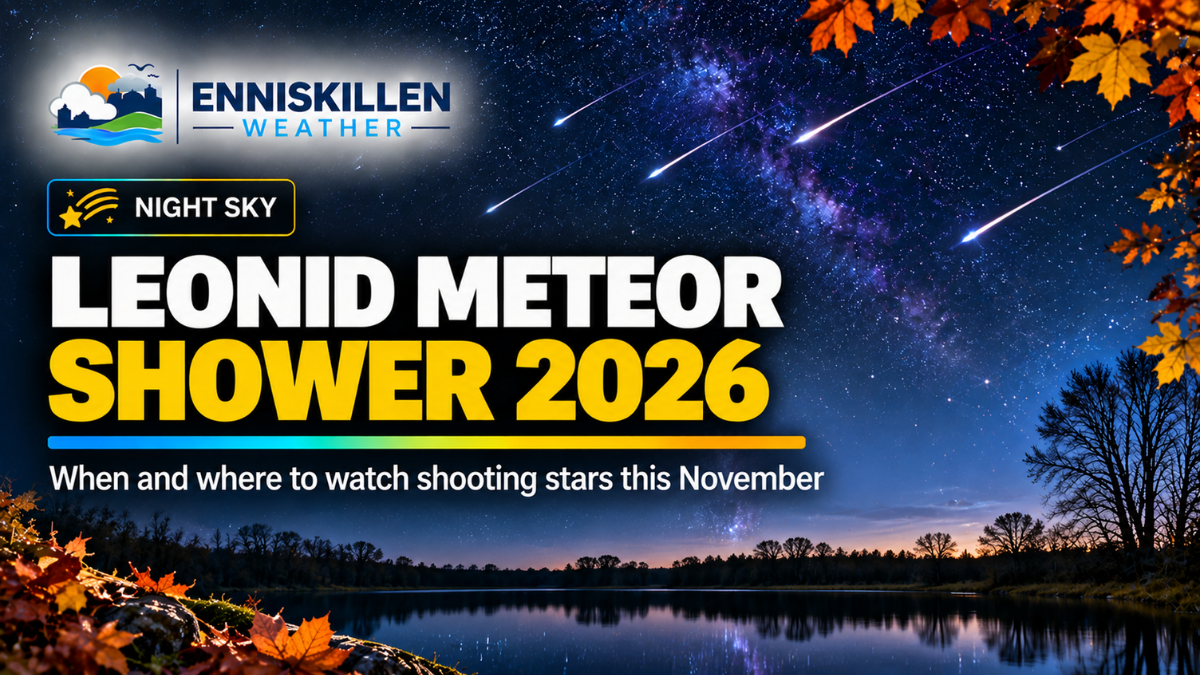
The Leonid meteor shower is returning, giving skywatchers across the UK and Ireland another opportunity to spot shooting stars streaking across the darkness.
And the good news is that you won’t need a telescope or any expensive equipment to enjoy it.
All you’ll need is a reasonably clear sky, somewhere away from bright lights and a little patience.
So, when should we be looking up here in Enniskillen and County Fermanagh?
When is the Leonid meteor shower in 2026?
The Leonid meteor shower is active from 6 to 30 November 2026, but the best opportunity to see it will be around its peak.
This year, the main peak is expected overnight on Tuesday 17 November into Wednesday 18 November.
The best viewing opportunities are likely to come after midnight and during the early hours of Wednesday morning, before dawn.
Although meteors can appear at other times during the shower, this is when you’ll generally have a better chance of spotting them.
Of course, we’ll also need the weather to cooperate!
What actually causes the Leonid meteor shower?
Despite being commonly called shooting stars, meteors aren’t actually stars at all.
The Leonids happen when Earth passes through a trail of tiny particles left behind by a comet called 55P/Tempel-Tuttle.
As these particles enter our atmosphere at tremendous speeds, they heat up and produce the bright streaks of light we see travelling across the sky.
And the Leonids are particularly fast!
Some travel at around 70 kilometres per second, making them among the fastest meteors associated with our annual meteor showers.
That incredible speed can produce bright flashes and, occasionally, colourful trails across the night sky.
How many shooting stars could we see?
Under ideal conditions, the Leonids can produce around 10 to 15 meteors per hour during their peak.
However, that doesn’t mean you’ll necessarily see one every four or five minutes.
Those figures are based on ideal viewing conditions, including very dark skies and a good view of the heavens.
In reality, the number you see will depend on cloud cover, light pollution, moonlight and how long you spend watching.
You might spot several within a short period, followed by a much longer wait before another appears.
That’s part of the fun of watching a meteor shower — you never quite know when the next shooting star will appear!
Where should you look in the sky?
The Leonids get their name from the constellation Leo, because the meteors appear to originate from that part of the sky.
During November, Leo rises in the eastern sky after midnight and climbs higher as the morning approaches.
However, you don’t need to spend the night searching for the constellation.
Although the meteors appear to come from Leo, they can streak across many different parts of the sky.
In fact, looking across a wide area of the sky rather than concentrating on one particular point can give you a better chance of spotting them.
If you’re watching from Fermanagh, find somewhere with a good, open view of the sky and as little artificial lighting as possible.
Will the Moon affect visibility?
There’s some encouraging news for anyone hoping to watch the Leonids this year.
The Moon reaches its first-quarter phase on 17 November, which means it will be fairly bright during the evening.
However, it should set around midnight, leaving the early morning hours with much less moonlight.
That’s helpful because a darker sky makes it easier to spot fainter meteors.
So, if the weather allows, the hours between midnight and dawn could offer some of the better viewing opportunities.
Can we see the Leonids from Enniskillen and Fermanagh?
Yes! The Leonid meteor shower is visible from Northern Ireland, including Enniskillen and County Fermanagh.
You don’t need to travel anywhere special to see it, although getting away from streetlights and other sources of light pollution will certainly help.
Rural areas with open views of the sky can provide better viewing conditions than brightly lit town centres.
But even from your own garden, you may still be lucky enough to spot a bright meteor if the sky is clear.
And remember, you don’t need binoculars or a telescope.
Your eyes are actually the best equipment for watching a meteor shower because they allow you to see a much wider area of the sky.
A few tips for watching the Leonids
If you’re planning to head outside, there are a few simple things worth remembering.
Give your eyes time to adjust. It can take around 20 to 30 minutes for your eyes to become properly accustomed to the darkness.
Avoid looking at your phone. Bright screens can affect your night vision, making faint meteors harder to spot.
Wrap up warm. November nights around Fermanagh can be rather chilly, particularly if you’re standing or sitting outside for a while.
Find somewhere dark. The less artificial light around you, the better your chances of spotting the fainter shooting stars.
Be patient. Meteor showers don’t produce a constant stream of shooting stars, so you may need to wait a while.
And perhaps most importantly, make sure you have a safe and comfortable place to watch from.
Will the weather cooperate?
As always, there’s one rather important factor we can’t control — the weather!
Even if the meteor shower reaches its peak exactly as expected, thick cloud cover could prevent us from seeing anything here in Fermanagh.
Clear or partly clear skies will give us the best opportunity.
It’s still too early to know exactly what the weather will be doing overnight on 17–18 November, but we’ll keep an eye on the forecasts as the event approaches.
A little bit of night-sky magic!
The Leonids have produced some spectacular displays throughout history, including rare meteor storms when enormous numbers of shooting stars have appeared.
We’re not expecting anything quite like that this year, but there’s still the possibility of seeing some beautiful meteors streaking across the November sky.
And sometimes, all it takes is one particularly bright shooting star to make standing outside on a chilly autumn night worthwhile.
So, if we get a break in the clouds around 17–18 November, it might be worth wrapping up warm, heading outside and spending a little time looking up.
You never know what you might see!